
 English
 中文简体
中文简体A cosmetic bottle pump is a dispensing mechanism that uses a spring-loaded piston and a one-way valve system to draw product from the container and deliver a measured dose with each press. The right pump type depends on your formulation viscosity, desired dose volume, preservation needs, and packaging material. Lotion pumps handle most liquid and cream formulas; airless pumps are essential for oxidation-sensitive actives; foam pumps transform low-viscosity liquids into aerated foam. This guide covers every type, every key spec, and every decision point — with data.
Why the Cosmetic Bottle Pump Is the Most Important Packaging Decision You Make
The cosmetic bottle pump is not a secondary packaging detail — it is a critical interface between your formulation and your consumer. It determines how much product is dispensed per use, whether air contaminates the formula, how the product feels during application, and whether the packaging can complete its full fill cycle without waste.
According to packaging industry research, cosmetic pump dispensers now account for over 34% of all primary cosmetic packaging globally, with the segment growing at approximately 6.2% CAGR through 2028. The growth is driven by consumer preference for hygienic, measured dispensing and brand investment in premium tactile packaging experiences.
A mismatched pump — wrong viscosity range, wrong output dose, wrong compatibility with the formulation chemistry — leads to product waste, consumer frustration, formulation degradation, and returns. Understanding the mechanics behind each pump type eliminates these risks.
How a Cosmetic Bottle Pump Actually Works: The Mechanics Explained
Every standard cosmetic bottle pump operates on the same fundamental principle — a sealed piston system with directional check valves. Here is the step-by-step mechanical sequence:
- Depression (downstroke): When you press the actuator head downward, the piston compresses the spring inside the pump chamber. This compression increases internal pressure, which forces the inlet check valve (at the bottom of the dip tube) shut and opens the outlet valve, allowing product to exit through the nozzle.
- Dispensing: Product travels up through the dip tube, into the pump chamber, and out through the nozzle in a single fluid motion. The amount dispensed per stroke — the output dose — is determined by the fixed volume of the pump chamber, typically between 0.5 mL and 4 mL per actuation.
- Return stroke (upstroke): When you release the actuator, the compressed spring forces the piston back up. This creates negative pressure (suction) inside the pump chamber. The outlet valve closes and the inlet valve opens, drawing fresh product up from the bottle through the dip tube to refill the chamber — ready for the next actuation.
- Priming: On first use, the pump chamber and dip tube contain only air. Most pumps require 3–8 priming strokes to displace this air with product before it dispenses correctly. This is normal behavior in all spring-piston designs.
The 5 Main Types of Cosmetic Bottle Pumps and When to Use Each
Each pump type is engineered for a specific viscosity range, formula sensitivity, and consumer use scenario. Selecting the wrong type wastes formulation and creates a poor user experience.
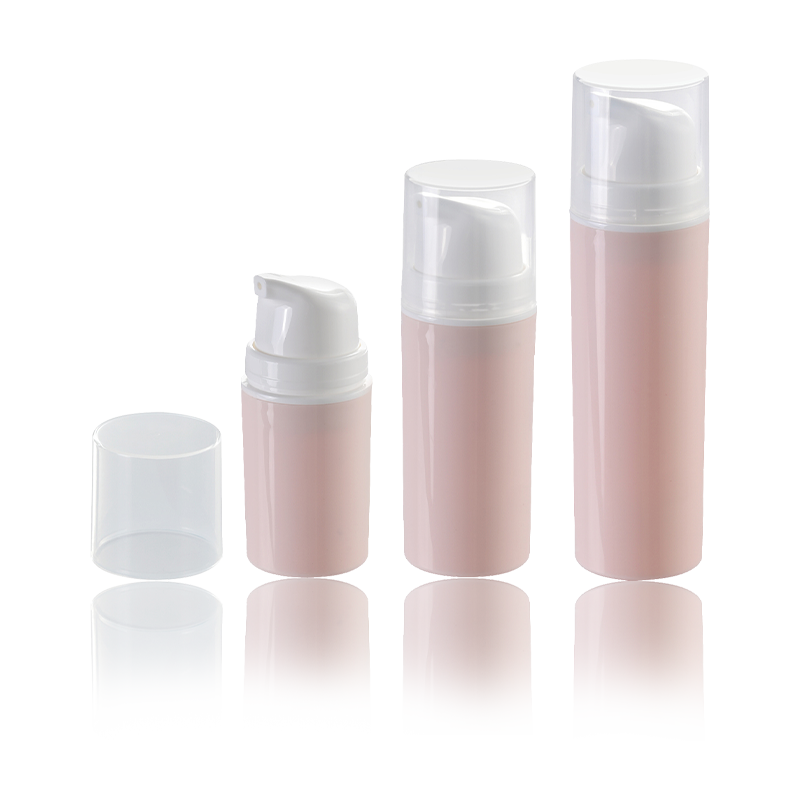
1. Standard Lotion Pump (PP Spring Pump)
The standard lotion pump is the most widely used cosmetic bottle pump in the market. It consists of a polypropylene (PP) housing, a metal or plastic spring, a dip tube, and an actuator. It handles formulas with viscosities of approximately 1,000–30,000 cP (centipoise) — covering most liquid serums, lotions, liquid soaps, shampoos, and light creams.
Standard output doses range from 0.8 mL to 3.5 mL per stroke. Common neck finishes include 24/410, 28/410, and 24/415 (the numbers denote the diameter and thread count of the bottle neck). This pump type is cost-effective, widely compatible, and available in matte, glossy, metallic, and custom-color actuator finishes for branding.
Best for: Lotions, liquid hand soaps, shampoos, conditioners, and light face creams.
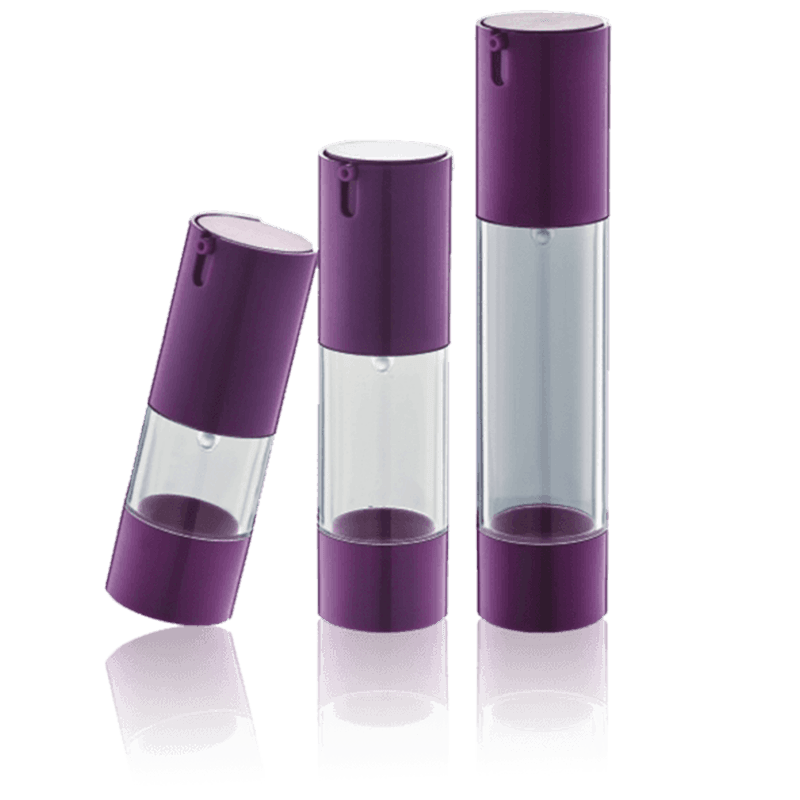
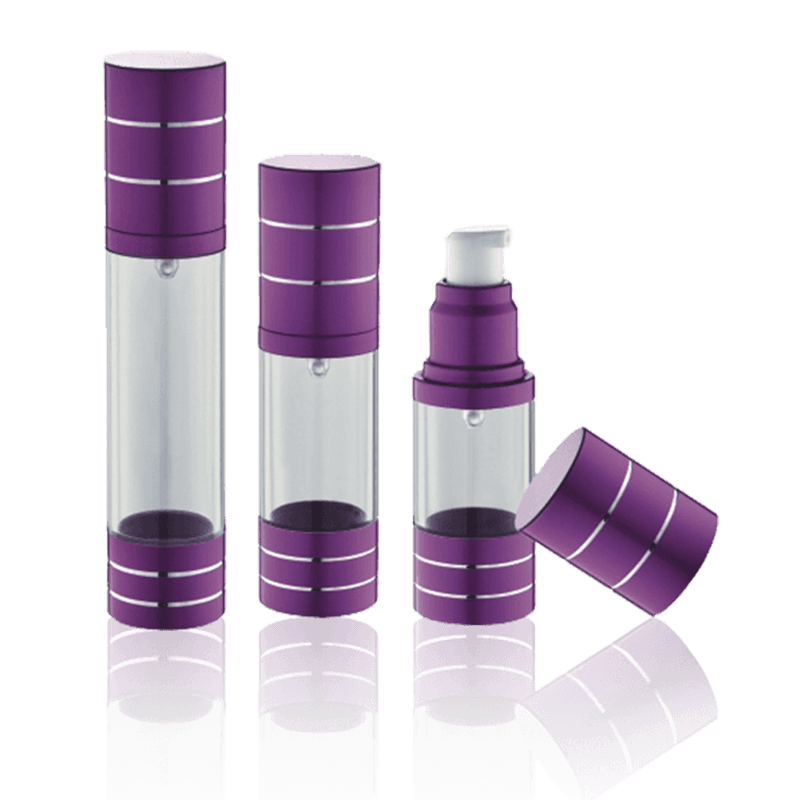
2. Airless Pump (Vacuum Dispensing System)
The airless pump is fundamentally different from a lotion pump. Instead of drawing product through a dip tube with atmospheric pressure re-entering the bottle, it uses a rising platform piston inside a sealed cylinder. As product is dispensed, the piston rises to fill the vacated space — meaning no air ever enters the product reservoir.
This architecture delivers two critical benefits: preservation of oxidation-sensitive active ingredients (vitamin C, retinol, bakuchiol, peptides) and near-100% product evacuation — compared to 85–90% evacuation typically achieved with dip-tube pumps. Airless pumps dispense smaller, more controlled doses, typically 0.3 mL to 1.0 mL per stroke.
Best for: Vitamin C serums, retinol treatments, peptide creams, anti-aging formulas, and any product requiring extended shelf stability after opening.
3. Foam Pump (Foaming Dispenser)
A foam pump contains two internal chambers: a small liquid chamber and a larger air chamber. When actuated, it simultaneously draws a measured amount of low-viscosity liquid and a larger volume of air, forcing both through a fine mesh screen that aerates the mixture into stable foam. The typical liquid-to-air ratio is approximately 1:7 to 1:10.
Foam pumps require formulations with viscosities of 1–500 cP — much lower than standard lotion pumps. They are widely used with surfactant-based cleansers, hand foams, facial cleansers, and shaving products. A key advantage is product efficiency: because air provides most of the volume, consumers use significantly less liquid per application — a foam cleanser bottle can last 40–60% longer than an equivalent liquid cleanser in a standard lotion pump.
Best for: Foaming cleansers, foam hand soaps, shaving foam, facial cleansing foam, and foam conditioners.
4. Fine Mist Spray Pump (Atomizer)
A fine mist spray pump forces liquid through a micro-orifice at high velocity to atomize it into a cloud of droplets, typically with a particle size of 50–150 microns. Unlike aerosol cans, no propellant is used — the mechanical action of the pump generates the spray pattern. Standard output per actuation is 0.08 mL to 0.15 mL, much lower than lotion pumps, making them ideal for products applied in thin layers.
Best for: Setting sprays, facial mists, toners, hair sprays, sunscreen mists, and body mists.
5. High-Viscosity / Cream Pump
High-viscosity pumps are engineered with a stronger spring tension, wider bore dip tube, and a larger-diameter piston chamber to handle thick formulas with viscosities from 30,000 to 300,000+ cP — encompassing thick body butters, heavy creams, hair masks, and gel foundations. Using a standard lotion pump with a high-viscosity product causes the pump to fail to prime or dispense completely.
Best for: Body butters, thick face creams, hair masks, clay-based formulas, and gel foundations.
Cosmetic Bottle Pump Types Compared
| Pump Type | Viscosity Range | Output per Stroke | Air Contact | Typical Price (per unit) |
| Standard Lotion Pump | 1,000–30,000 cP | 0.8–3.5 mL | Yes (via dip tube) | $0.10–$0.60 |
| Airless Pump | 500–50,000 cP | 0.3–1.0 mL | None | $0.80–$3.50 |
| Foam Pump | 1–500 cP | 0.4–1.2 mL (liquid) | Yes (intentional) | $0.25–$1.20 |
| Fine Mist Spray | 1–200 cP | 0.08–0.15 mL | Yes (via dip tube) | $0.15–$0.80 |
| High-Viscosity / Cream Pump | 30,000–300,000+ cP | 1.0–4.0 mL | Yes (via dip tube) | $0.20–$1.00 |
Table 1: All five major cosmetic bottle pump types compared across viscosity range, output dose, air exposure level, and approximate per-unit cost at volume. Use this table to narrow down the right pump format before specifying materials or finish.
Key Specifications to Understand When Sourcing a Cosmetic Bottle Pump
When specifying or ordering a cosmetic bottle pump, these six parameters must be matched precisely to both the bottle and the formulation:
- Neck Finish (diameter × thread): This is the most critical fit dimension. The most common sizes in cosmetics are 24/410 (24mm diameter, 410 thread style), 28/410, and 24/415. A pump specified for 24/410 will not seal correctly on a 28/410 bottle. Always verify neck finish with your bottle supplier before sourcing pumps.
- Output Dose (mL per actuation): This defines how much product is dispensed per press. Common options are 0.5 mL, 1.0 mL, 1.5 mL, 2.0 mL, and 3.0 mL. Choosing the wrong dose wastes product (too much) or frustrates consumers who need multiple pumps for a single application (too little). For facial serums, 0.5–1.0 mL is standard; for body lotion, 2.0–3.5 mL.
- Dip Tube Length: The dip tube must reach within 2–5 mm of the bottle base to maximize product evacuation. If the tube is too short, up to 15–20% of the fill volume may remain inaccessible at the end of the bottle's life. Most suppliers can cut dip tubes to custom lengths.
- Stroke Length (mm): The distance the actuator travels from its resting position to the fully depressed position. Shorter stroke lengths (under 12 mm) give a "premium" feel but may reduce output per actuation. Longer strokes (15–20 mm) are more practical for thick formulas.
- Actuator Orifice Size (mm): The opening in the nozzle tip determines the stream pattern. A 0.35–0.5 mm orifice produces a narrow stream for thick lotions; a 0.2–0.3 mm orifice atomizes thinner liquids into a mist. Mismatching orifice size to viscosity creates dripping or complete clog.
- Material Compatibility: Pump internals must be chemically compatible with the formulation. High-alcohol products (above 30% ethanol) can degrade standard PP gaskets over time, requiring LDPE or stainless-steel components. Formulas with essential oils or high concentrations of propylene glycol may swell or soften certain plastics — always request a compatibility test or COC from the supplier.
Airless vs. Standard Lotion Pump: A Direct Comparison
The choice between an airless pump and a standard lotion pump is the most consequential packaging decision for skincare brands. Here is a side-by-side analysis across every relevant dimension:
| Factor | Airless Pump | Standard Lotion Pump |
| Air exposure to formula | None | Present (via dip tube) |
| Product evacuation rate | 95–99% | 85–92% |
| Preservative load required | Lower | Standard to higher |
| Cost per unit (at 10,000 MOQ) | $0.80–$3.50 | $0.10–$0.60 |
| Compatible fill volume | 10–100 mL (typical) | 30–1,000 mL |
| Refillable / recyclable | Difficult (sealed chamber) | Easier to disassemble |
| Best application | Vitamin C, retinol, peptides | Lotion, shampoo, hand soap |
| Consumer experience | Premium, precise | Familiar, versatile |
Table 2: Direct comparison of airless pump vs. standard lotion pump cosmetic bottle dispensers across eight key evaluation criteria. For premium actives and oxidation-sensitive formulations, the airless system justifies its higher cost.
Materials Used in Cosmetic Bottle Pumps: What Each Component Is Made From
Understanding the materials in a cosmetic bottle pump is essential for compatibility testing, regulatory compliance, and sustainability claims. Here is a breakdown of each component:
- Housing and actuator — Polypropylene (PP): PP is the default material for pump bodies and actuators. It is lightweight, chemically resistant to most cosmetic ingredients, and can be injection-molded into complex shapes. PP is also widely accepted in curbside recycling streams, making it a preferred material for sustainability-positioned brands.
- Spring — Stainless Steel (304 or 316 grade): Standard pump springs are stainless steel, providing consistent return force over thousands of actuations. For high-alcohol or salt-containing formulas, 316-grade stainless (marine grade) offers superior corrosion resistance. Plastic springs (PP or POM) are available for "all-plastic" recyclable pump designs.
- Gaskets and seals — LDPE or EPDM: Internal gaskets form the one-way valve seals. Low-density polyethylene (LDPE) is standard for most cosmetic formulas. EPDM (ethylene propylene diene monomer) gaskets are used when higher chemical resistance is required, particularly with essential oil-heavy or high-pH formulations.
- Dip tube — LDPE or PP: The dip tube is typically semi-rigid LDPE or PP. Length is customizable. For highly viscous formulas, a wider-bore (4–5 mm inner diameter) dip tube ensures product flow without collapse under suction.
- Actuator orifice insert — PE or POM: The nozzle tip insert that determines spray or stream pattern. Polyoxymethylene (POM / Delrin) is preferred for mist pumps due to its dimensional precision and resistance to distortion at the micro-orifice scale.
Sustainable and Eco-Friendly Cosmetic Bottle Pump Options
The conventional cosmetic bottle pump is notoriously difficult to recycle because it combines multiple materials (metal spring, PP housing, LDPE gaskets) that cannot be separated in standard recycling streams. The beauty industry is actively developing alternatives:
- All-Plastic Pumps (PCR PP): Pumps engineered with a PP spring (instead of stainless steel), PP gaskets, and PP housing can be presented as mono-material recyclable. Post-consumer recycled (PCR) PP is available at up to 50% PCR content without significant performance reduction. These pumps carry recyclability claims that satisfy EU packaging regulations and FTC Green Guides.
- Refillable Pump Systems: Some premium brands design pump systems where the pump collar remains on a permanent outer housing while an inner refill pod is replaced. This reduces packaging waste per use by up to 70% compared to full-unit replacement.
- Bio-Based PP: Emerging bio-polypropylene derived from sugarcane (bio-PP) offers a chemically identical material to fossil-derived PP with a significantly lower carbon footprint. It is currently available at a 20–40% price premium over standard PP.
- Aluminum Actuators: Anodized aluminum actuators are increasingly used on luxury cosmetic pump packaging for a premium tactile and visual experience, replacing matte PP. Aluminum is infinitely recyclable and adds significant perceived value.
Common Cosmetic Bottle Pump Problems and How to Solve Them
Even a correctly specified cosmetic bottle pump can fail due to formulation incompatibility, improper assembly, or consumer misuse. Here are the most common problems and their causes:
| Problem | Most Likely Cause | Solution |
| Pump won't prime after many strokes | Inlet valve stuck or dip tube too short | Check dip tube length; purge valve with warm water |
| Product drips after each actuation | Outlet valve worn or orifice too large | Replace pump; reduce orifice size |
| Inconsistent dose per stroke | Air bubble trapped in chamber | Invert bottle briefly; re-prime |
| Pump seizes or becomes stiff | Formula dried in piston chamber | Soak actuator in warm water 5 min |
| Foam pump producing liquid, not foam | Formula viscosity too high (>500 cP) | Dilute formula or switch to lotion pump |
| Pump leaks around collar | Neck finish mismatch | Verify pump neck finish matches bottle spec |
Table 3: Common cosmetic bottle pump failure modes with their root causes and corrective actions. Most pump issues trace back to either a formulation mismatch or an incorrect specification at the sourcing stage.
Frequently Asked Questions About Cosmetic Bottle Pumps
Q: What is the difference between a lotion pump and an airless pump?
A standard lotion pump draws product through a dip tube using atmospheric pressure, meaning air enters the bottle as product is removed. An airless cosmetic pump uses a rising internal piston to push product toward the nozzle, so no air ever contacts the formula. Airless pumps cost significantly more per unit ($0.80–$3.50 vs. $0.10–$0.60) but are essential for preserving oxidation-sensitive actives like vitamin C and retinol.
Q: How do I know which pump size fits my bottle?
The critical measurement is the neck finish — specifically the outer diameter and thread type of your bottle opening. The most common sizes are 24/410 and 28/410. Measure the diameter of your bottle's neck opening in millimeters and confirm the thread style with your bottle supplier. A pump labeled 24/410 will only fit a 24/410 neck — attempting to fit a 28/410 pump will result in leaking or failure to seat.
Q: Why does my cosmetic pump need so many strokes before it dispenses?
This is normal — it is called priming. On first use (or after extended storage), the dip tube and pump chamber are filled with air, not product. The initial strokes displace this air. Most pumps prime within 3–8 strokes. If a pump requires significantly more strokes than this, the dip tube may be too short to reach the product, or the inlet valve may be partially obstructed.
Q: Can I use a foam pump with any liquid soap or cleanser?
No — foam pumps require formulas with a viscosity below approximately 500 cP and a high water content. The formula must also contain surfactants that generate stable foam when aerated. Standard thick body washes or cream cleansers are too viscous and will clog a foam pump or produce liquid output rather than foam. Foam pump formulas are typically diluted to a 3–7% active surfactant concentration.
Q: Are cosmetic bottle pumps recyclable?
Standard pumps are technically recyclable but not accepted in most curbside programs because they combine metal springs with plastic components. To recycle, the pump must be disassembled and materials separated. All-plastic mono-material pumps (with PP springs instead of steel) resolve this issue and are accepted in PP recycling streams. Brands seeking recyclability claims should source certified mono-material pumps and clearly communicate disassembly instructions on-pack.
Q: What output dose should I specify for a facial serum pump?
For facial serums, 0.5 mL per actuation is the most common and appropriate dose — sufficient for full face coverage in one pump for most lightweight serums. High-cost formulations (peptides, growth factors) often use 0.3 mL doses to slow consumption. Anything above 1.0 mL per pump for a facial serum leads to product waste and consumer complaints of a "greasy" or oversaturated application experience.
Q: What is a lock-down or travel-lock feature on a cosmetic pump?
Many cosmetic bottle pumps include a lock-down collar — a rotating ring on the pump neck that, when twisted to the locked position, physically blocks the actuator from being depressed. This prevents accidental dispensing during shipping and travel. Most locking pumps require a quarter-turn (90°) counterclockwise to unlock before first use. Without this feature, liquid products routinely leak during transit, creating costly returns and consumer dissatisfaction.
How to Choose the Right Cosmetic Bottle Pump: A Simple Decision Framework
Selecting the correct cosmetic bottle pump requires answering four sequential questions:
- What is your formula's viscosity? Below 500 cP → consider foam or fine mist. 1,000–30,000 cP → standard lotion pump. Above 30,000 cP → high-viscosity cream pump. Airless spans 500–50,000 cP for sensitive formulas.
- Does the formula contain oxidation-sensitive actives? If yes (vitamin C, retinol, bakuchiol, peptides) → airless pump is mandatory, not optional.
- What neck finish does your bottle have? Confirm the diameter and thread type (24/410, 28/410, etc.) before any pump sourcing conversation.
- What dose is right for your product category? Facial serum: 0.5 mL. Body lotion: 2.0–3.5 mL. Setting spray: 0.1 mL. Match dose to application ritual, not to bottle size.
A correctly matched cosmetic bottle pump is invisible to the end consumer — it works exactly as expected, every time, until the last drop of product is dispensed. A mismatched pump, by contrast, becomes the most-mentioned complaint in reviews, drives returns, and undermines even the most effective formulation. Invest the time to specify correctly, and your packaging will enhance rather than detract from your product's performance.