
 English
 中文简体
A serum that turns brown in six weeks and a scalp treatment that squirts twelve drops when the pack promises three usually trace back to the same packaging decision: a bottle that lets air back in and cannot measure what it delivers. A syringe airless bottle solves both problems at once. It is a non-pressurised vacuum dispenser with a slim, syringe-like body, a follower piston instead of a dip tube, and a head that reseals after every stroke, so the formula stays isolated from air until the moment it leaves the nozzle.
That is the short version. The detail that decides whether the pack works on a filling line comes down to four things: usable fill volume, dose per stroke, neck finish, and the quality of the piston seal.
What a Syringe Airless Bottle Actually Is
A syringe airless bottle is an airless (vacuum) package whose body and dosing behaviour imitate a syringe: product sits in a piston-sealed chamber and each press releases a fixed, small dose through a narrow tip.
Three formats dominate the category, and they are not interchangeable:
- Slim syringe body, 10–30 ml. Long piston travel relative to diameter, so the dose stays steady even when the bottle is nearly empty.
- Syringe-style applicator head. A narrow tube or needle-like nozzle that lets the user place the dose directly on skin, scalp or cuticle.
- Standard airless body with a fine-tip actuator. The cheapest route when a brand wants airless precision but not the syringe silhouette.
| Question | Syringe airless bottle | Dropper bottle | Glass pipette |
|---|---|---|---|
| Air contact during use | None; the piston closes the gap | Air enters each time the dropper returns | Air enters when the pipette refills |
| Dose repeatability | ±5–10% until the final 5% of fill | Depends on how hard the user squeezes | Depends on how hard the user draws |
| Oxidation protection | High, almost no headspace | Low, large headspace | Medium |
| Preservative load | Often reducible | Usually a full system | Medium |
| Unit cost | Highest of the three | Lowest | Medium to high |
| Best fit | Actives, scalp care, premium serums | Toners, essences, entry sets | Treatment oils, samples |
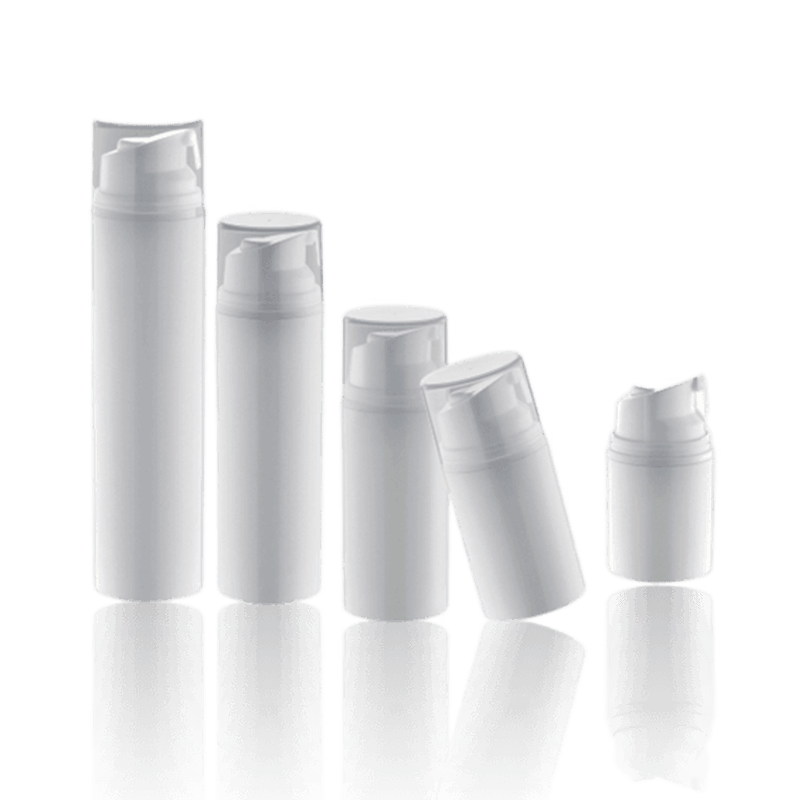
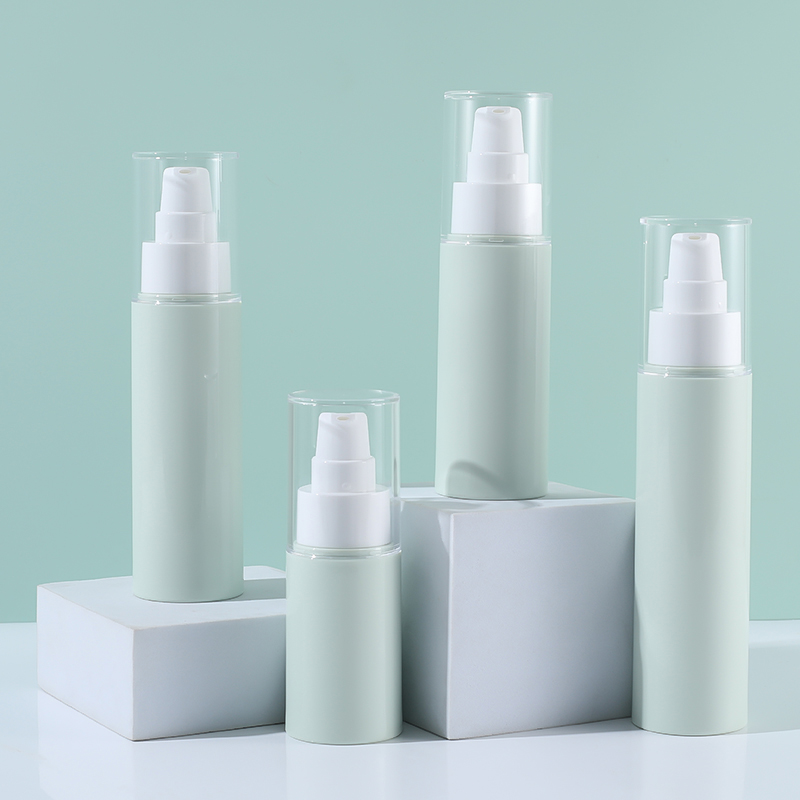 HS-017A Airless Cosmetic Pump Bottle for Skin CareAirless pump bottle in 50, 80, 100 and 120 ml sizes, with vacuum piston protection for active skincare formulas.View Product →
How the Airless Mechanism Works
An airless bottle does not pull liquid up a dip tube; it vacuums the formula from below and lets the base of the pack rise behind it, which is why no air ever enters the chamber.
- The user presses the actuator, opening a small inlet valve in the pump chamber.
- Formula is drawn into the chamber from the sealed body.
- On release, the outlet valve opens and the metered dose leaves the nozzle.
- Pressure inside the bottle drops slightly, so the follower piston moves up by exactly the volume dispensed.
Two consequences follow. First, viscosity stays as filled, because there is no headspace for evaporation or for the formula to thicken at the surface. Second, the piston travel becomes the dose, so a longer slim body with a small cross-section is easier to control than a short, wide one. The same mechanism is described from the moulding side in this comprehensive guide to cosmetic airless bottles.
Where Syringe Airless Bottles Earn Their Cost
They pay off in high-value, low-viscosity or oxygen-sensitive formulas where dose accuracy matters more than unit price.
- Scalp serums and hair-growth liquids dosed drop by drop onto the parting.
- Spot correctors and blemish gels applied to a small target area.
- Eye, lash and brow serums where 0.1 ml too much becomes a smear.
- Retinol, vitamin C and other actives that discolour when exposed to air.
- Cuticle oils, hand serums and travel sizes where leakage ruins the bag.
For categories where the formula is cheap and the consumer expects to pour, a dropper still wins. The practical dividing line is whether the pack carries a claim such as "one press, one dose" or "no preservatives added" — if it does, the airless body has to deliver it. Design decisions such as clarity, label area and drop control are examined in these notes on skin care product packaging design details.
Key Specifications to Check Before You Order
Five numbers decide whether the pack survives production: usable fill, dose per stroke, neck finish, dose tolerance and piston material.
| Parameter | Typical range | Why it matters | Common failure |
|---|---|---|---|
| Nominal capacity | 10, 15, 20, 30, 50 ml | Sets perceived value and number of uses | Oversized body looks half empty |
| Usable fill | 80–90% of nominal | Leaves room for piston travel | Overfilling bursts the seal |
| Dose per stroke | 0.15–0.5 ml | Defines the "one dose" claim | 0.8 ml doses waste costly actives |
| Neck finish | Ø13, 15, 18, 20, 24 mm | Must match pump and over-cap | Mismatched neck leaks and wobbles |
| Body material | PP, AS, PETG, PCTA | Formula compatibility and clarity | PETG hazes; PCTA raises cost |
| Piston seal | PE piston with silicone lip | Controls contact and travel | Cheap seals stick after eight weeks |
| Dose tolerance | ±10% at 25 °C | Used for line validation | Claims fail on stability testing |
| Decoration | Silk screen, offset, hot stamp, metallising | Sequence affects moulding | Plating on the seal area stops the pump |
Treat the fill volume as a working range, not a target. A 15 ml body that is filled to 14 ml has almost no piston travel left, and the first press will feel stiff or refuse to return.
Common Failure Points and How to Avoid Them
Most airless complaints come from filling and storage, not from the mould, so fix the process before blaming the tooling.
- Trapped air. Formula should be de-aerated or given a slow, bottom-up fill; bubbles in the chamber show up later as dose drift.
- Fast filling. A high line speed pushes the piston up before the body is capped, which distorts the seal.
- Long side storage. Piston lips can dry against the wall; specify a material grade that tolerates the shipping and shelf period you actually need.
- High-viscosity cream. Very thick formulas need a wider inlet or a larger dose chamber, otherwise the actuator creeps back slowly.
- Decoration on curvature. A slim syringe body has little flat area, so artwork must be pre-distorted or it will read crooked after printing.
A simple pre-production check covers most of this: dose consistency at start, middle and end of fill; a 40 °C stability run; a drop test on the capped unit; and a squeeze test on the seal joint.
The Dispensing Head, the Cap and the Assembly
The head is where the syringe feel is created: a spring-return airless pump, an actuator with a narrow nozzle, and a cap that keeps the tip clean.
Dose is set by chamber volume, not by how far the user presses, so once the chamber is chosen the rest of the head is about ergonomics and finish. Locking actuators suit travel kits; needle or slit nozzles suit targeted application; over-caps in flip, screw or disc styles protect the tip and carry the brand mark. Because pump, bottle and cap are matched parts, they should be sampled as one assembly rather than ordered separately and hoped for the best.
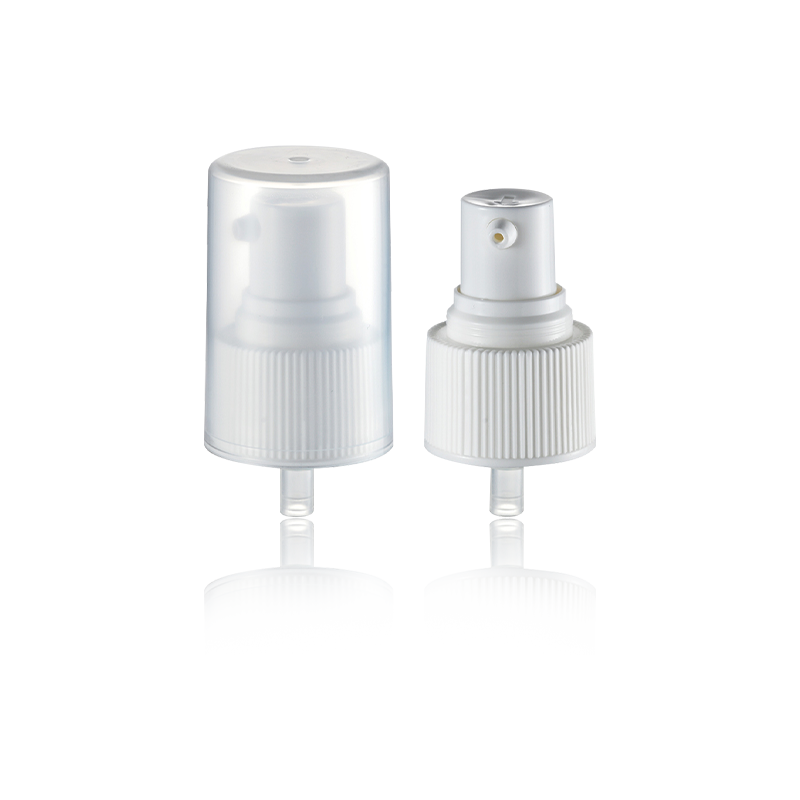 HY24A-01 Silky Spring Cosmetic Pump Head for SkincarePrecision pump head for lotions, essences and sunscreens, with smooth spring action, double sealing and customizable liquid output.View Product →
Customising, Tooling and Sourcing Practicalities
Timeline is decided by tooling ownership and sample approval, not by the bottle drawing, so settle those two first.
Ask who owns the mould, whether the existing pump tooling can be reused, and how many decoration passes the body allows. Electroplating or metallising generally has to happen before assembly, never after, because overspray in the seal area will stop the piston. Airless bottle programmes usually run through a chain of base colour, print or hot stamp, then electroplating, with a pre-production sample approved for both appearance and dose.
Working with a manufacturer that already holds a broad airless tool bank shortens the sampling loop. Yuyao Hongsheng Commodity Co., Ltd., an OEM cosmetic packaging manufacturer based in Yuyao, Zhejiang, operates airless moulds numbered from hs001a through hs038 alongside matched pumps, caps and set combinations, and accepts sample-based customisation — which means a brand can test a real bottle before committing to new tooling.
 HS-030A Airless Lotion Bottle and Cream JarConvertible airless packaging in 15–50 ml sizes, using vacuum preservation and bottom piston technology for creams, lotions and travel skincare.View Product →
FAQ
Does "syringe" mean the bottle contains a needle?
No. The word describes the slim silhouette and the precise dose. A fine nozzle or a soft applicator tip replaces the needle, and nothing pierces the skin.
Can a syringe airless bottle handle oil-based formulas?
Yes, provided the body and piston grades are compatible. AS and PCTA suit many oil systems; PP is the workhorse for water-based and alcohol-light formulas.
Is it refillable?
Standard units are not, because the follower piston seals against the wall and cannot be reset at home. Refillable airless designs exist, but they need a different mechanism and a higher unit cost.
What determines the minimum order quantity?
Decoration method and colour usually set the floor, not the bottle itself. Stock moulds with a standard pump keep the entry point low; a new body mould shifts the conversation to tooling cost.
A syringe airless bottle is not a fashion choice. It is the format you choose when the formula is expensive, oxygen-sensitive or dosed in fractions of a millilitre, and when the pack has to keep that promise for eighteen months on a shelf. Confirm the fill range, the dose, the neck finish and the seal grade, test the assembly as one unit, and the syringe silhouette becomes a detail rather than a risk.