
 English
 中文简体
中文简体A packaging manager asked a fair question during a sampling review: if the bottle is recyclable but a quarter of the serum never leaves it, is the pack really sustainable? That question shapes the entire brief. In airless packaging, three things decide a cosmetic bottle's footprint, and the resin is only one of them — how much product the consumer can actually empty, whether the pack can be refilled or recycled as one material, and how much material is spent per dose.
An airless bottle, defined plainly, is a rigid container with no dip tube: a piston or a collapsing inner pouch rises as the pump draws product down, so the formula meets air only at the nozzle. That single design fact is why airless packs reach sustainability figures that ordinary pump bottles struggle to match.
The short answer: the most defensible sustainable airless bottle for cosmetics today is a mono-material polypropylene or high-PP PCR bottle with a refillable inner cup and a piston that evacuates at least 90 percent of the fill, decorated in a way that keeps the body mono-material. Glass, bioplastic and certification logos are secondary decisions that should follow those four, not lead them.
What Counts as a Sustainable Airless Bottle
Sustainability in an airless bottle is a sum of measurable design choices, not a label printed on the carton. Four criteria carry most of the weight, and every one of them can be checked with a sample and a scale rather than a certificate.
- Mono-material construction. A bottle, piston, pump body and collar in the same polymer family, usually polypropylene, can be recycled in one stream. Polypropylene mixed with metallized ABS and a steel spring usually cannot.
- A real refill or reuse path. If the consumer keeps the decorated shell and the pump and replaces only the inner cup, material per use drops sharply.
- High evacuation rate. Formula left inside the pack is waste paid for twice: once at the filling line, once at disposal.
- Low material weight per delivered dose. A shorter, thinner-walled 50 ml bottle outperforms heavy glass for most skincare unless glass reuse is guaranteed by a deposit scheme.
A fifth factor works indirectly. Because an airless pack keeps oxygen away from the formula, preservative and antioxidant loads can often be reduced — a downstream benefit that packaging rarely gets credit for.
How the Airless Mechanism Reduces Waste
A properly tuned piston airless bottle evacuates roughly 90 to 95 percent of the fill, against about 70 to 80 percent for a conventional dip-tube pump of the same nominal volume. That gap is the most measurable sustainability number in the whole pack, and it is decided by piston fit and pump geometry rather than by the resin.
Three consequences follow. First, far less product is thrown away with the container, which for a high-value serum can outweigh the packaging footprint entirely. Second, because the formula never returns into the bottle and contacts air only at the nozzle, oxidation-sensitive actives such as vitamin C derivatives hold up better. Third, an airless pack can be filled with minimal headspace, so the bottle can be shorter and lighter than a dip-tube bottle holding the same volume.
There is a limit worth knowing before you commit a formula. High-viscosity creams and products with large exfoliating particles can jam a piston or clog the outlet, and some volatile carriers interact with elastomer seals. Those are the cases where a pouch-type airless system or a dedicated cream pump usually wins. If you want a deeper look at piston travel and outlet design, the notes in this article on cosmetic airless bottle knowledge cover the internal construction in detail.
Material Choices for an Airless Cosmetic Bottle
For most skincare launches, mono-material PP beats glass, PET and bioplastic on the balance of recyclability, weight and cost — but only if the decoration follows the same logic. The table below summarises how the main options behave in practice.
| Material | Recycling fit | Best suited to | Watch-outs |
|---|---|---|---|
| Mono-material PP | Strong in the PP stream | Mainstream skincare, 15 to 100 ml | Limited clarity; decoration must be PP-compatible |
| PCR-PP (30 to 100 percent recycled) | Strong; supports recycled-content claims | Brands with published PCR targets | Colour and odour vary between lots; approve each batch |
| PET and PETG | Good, but only if separated from the pump | Clear or thick-walled visual packs | Pump and piston are usually a different polymer |
| Glass with PP pump | Moderate; two streams to split | Premium serums in refill programmes | Weight, breakage in transit, higher freight emissions |
| Metallized or plated body | Poor unless the plating is PP-safe | Short-run gift sets | Often disqualifies the pack from mono-material claims |
Two notes that matter at the filling line. First, recycled content changes melt flow, so wall thickness and piston fit should be re-validated when you move from virgin PP to a recycled blend. Second, printing and plating are usually decided after the bottle is approved; decide them together with the material, or a mono-material pack quietly becomes a mixed-material one.
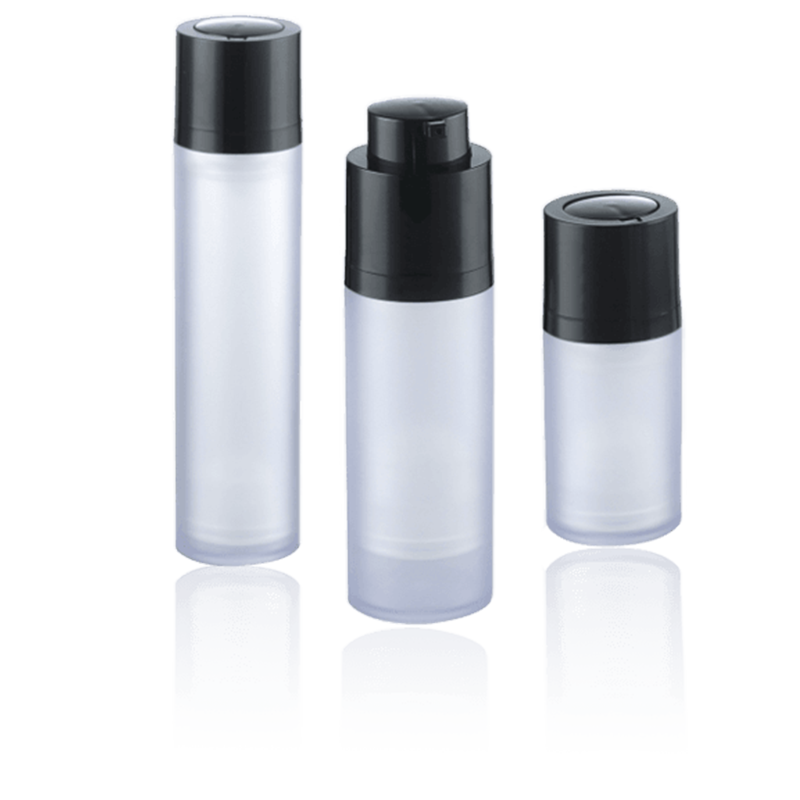
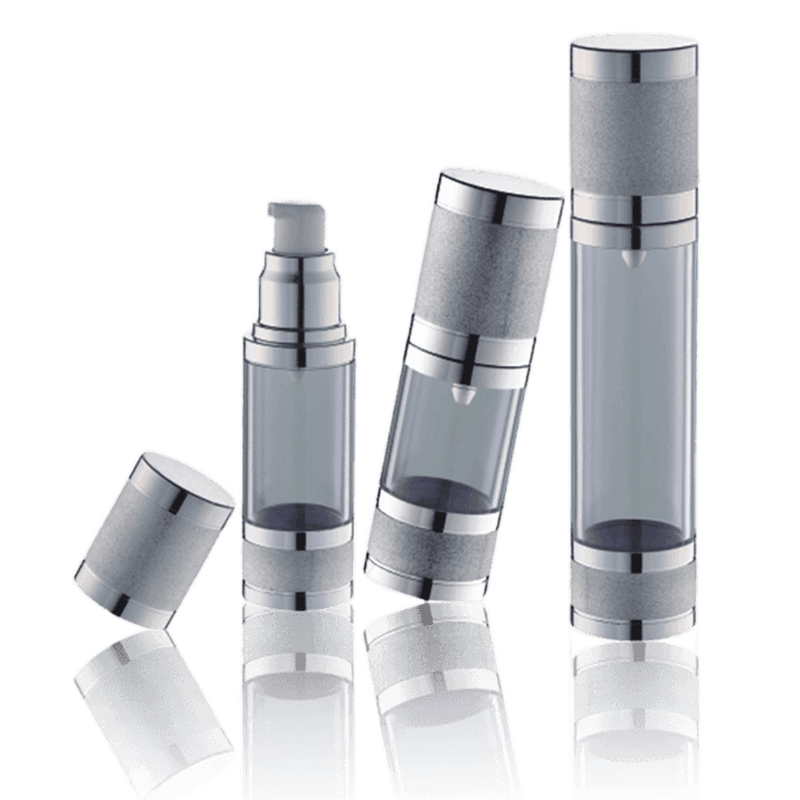 HS-010A Frosted Mist Vacuum Airless Bottle 15–50 mlExplore HS-010A 15–50 ml frosted mist vacuum airless bottles with atomizing nozzle and 360° spray; relevant when considering refill and mono-material packaging.View Product →
Refill and Reuse: Where the Savings Are Actually Largest
The biggest measurable saving in an airless system almost never comes from the resin; it comes from reusing the outer shell and pump and replacing only the inner cup. A refill cup for a 50 ml pack typically weighs a good deal less than the complete bottle, and because the decorative shell stays with the consumer, refill cycles avoid printing and plating altogether.
Two refill architectures dominate, and they behave differently in the hand:
- Twist-lock inner cup: the cup unscrews from the base and a new one locks in. Sturdy, tool-friendly, and the most common choice for jars and wide bottles.
- Snap-in cartridge: the cartridge presses into the shell and is released by a small tab. Slimmer and cheaper to mould, but the release mechanism has to survive repeated use.
One practical warning: a refill only delivers its benefit if the consumer can complete the swap without tools and without touching the piston. If a QR video is required, adoption drops. Refill economics also assume the outer shell survives at least two cycles, which puts pressure on scratch resistance and on the wear of the collar thread.
Buying the bottle, pump and overcap as a matched set removes the most common failure mode in refillable airless packaging, which is a shell from one supplier and a cup from another that almost fit.
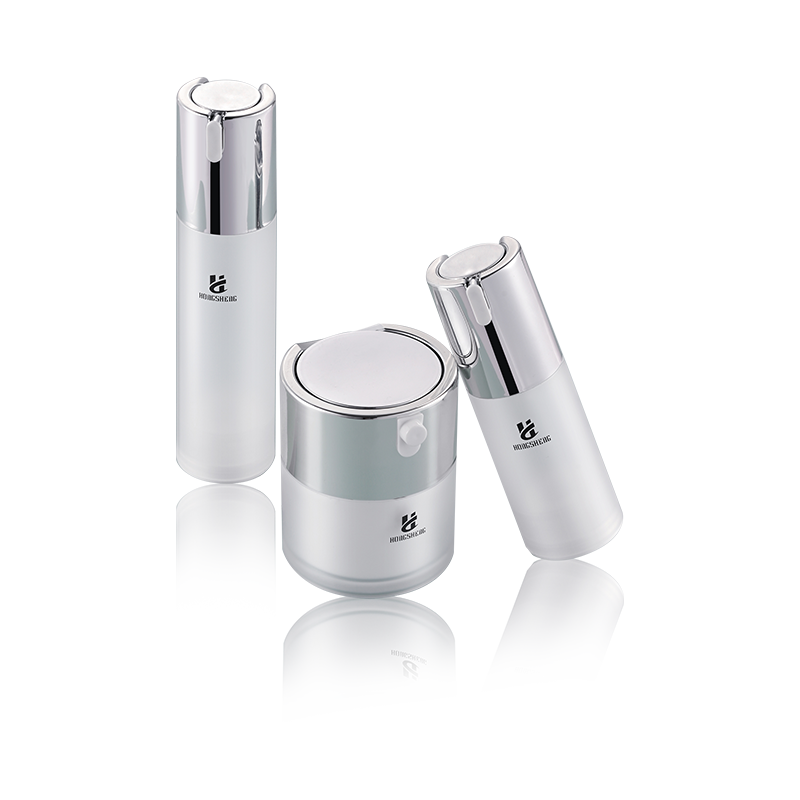 TZXL-001 Skin Care Bottle Set 30 ml, 50 ml, 30 gMatched 30 ml, 50 ml, and 30 g set with vacuum preservation and precise pump; suited for checking assembled airless pack performance.View Product →
What to Verify on a Sample Before You Approve It
Approve an airless pack on measured performance, not on a datasheet figure. These six checks take about a day in the lab and prevent most field complaints.
- Evacuation rate. Fill, dispense until the pump runs dry, then weigh the residue. Anything below 90 percent should be re-engineered before tooling is cut.
- Dose consistency. Ten consecutive actuations should fall within roughly plus or minus five percent of the nominal dose, at 20 degrees Celsius and again after a cold cycle.
- Leakage and piston creep. Store upright and inverted at 40 degrees Celsius and 75 percent relative humidity for four weeks, then inspect the collar and base for seepage.
- Drop and transit. Test the shoulder and the base at 1.2 metres, or to your retailer standard, plus a vibration simulation for export cartons.
- Decoration adhesion. Cross-hatch plus 24 hours of water immersion, especially on plated collars where peeling starts at the seam.
- Function after decoration. Plating and painting change the friction between piston and wall, so re-measure the dose after decoration, not before.
Cost, MOQ and Lead Time: the Practical Side
Sustainable airless bottles usually carry a modest premium, often single-digit percentages over standard packs, but the real cost drivers are tooling, order quantity and decoration rather than recycled resin.
Mono-material design tends to reduce mould count, because the pump, collar and piston can share a polymer family and sometimes a family of moulds. PCR supply is the volatile part: prices move with the recycled feedstock market, and colour consistency has to be controlled batch by batch, so buyers should lock a colour standard and a tolerance before the first production run.
As a rough planning baseline for a custom airless bottle, expect new tooling to add several weeks, sampling to take one to two weeks, and mass production plus freight to add another month. Decorated parts add time on top, and any decoration that touches the piston chamber should be scheduled before the final function test rather than after it.
Supplier structure matters as much as specification. A factory that controls moulding, printing and plating under one roof shortens the loop between a refill-fit problem and its fix, because the pump, the cup and the shell are not three separate conversations. That vertical setup is also what makes sample-based customisation practical, and it is the model most buyers now look for when they brief a custom cosmetic packaging factory for an airless project.
Frequently Asked Questions
Are airless bottles actually recyclable?
Only when the parts share a polymer family. A mono-material PP bottle with a PP pump, PP piston and PP overcap can enter the PP recycling stream. Add a metallized collar, a steel spring and a different-polymer piston and the pack becomes hard-to-recycle regardless of what the bottle alone is made of.
Is a refillable airless bottle more expensive per unit?
The first purchase is, typically by a single-digit percentage, because the shell is built to last longer. Across two or three refill cycles the cost per millilitre usually falls below the disposable equivalent, and the brand keeps the decoration investment working for years instead of one season.
Do airless packs still need preservatives?
Most formulas still use some, but the level can often be reduced because the product never returns into the bottle and oxygen contact is limited to the nozzle. That is a formulation decision, not a packaging claim, and it should be confirmed with a challenge test rather than assumed.
Yes. Frosted PP, soft-touch coatings that stay within the PP stream, hot stamping on the outer shell rather than the body, and a well-weighted collar all read as premium in hand. What breaks the premium impression is a mismatch between the visible finish and the weight of the pack.
Briefing a Sustainable Airless Bottle in One Page
Write the brief around performance you can measure, then let the sustainability story follow it. Specify the volume and dose, the formula viscosity, the required evacuation rate, the refill architecture, the polymer family for every component, and the decoration process — in that order. Add the transit standard and the climate the product will ship through, and ask for a filled sample rather than an empty one.
Done that way, the sustainability claim stops being a marketing sentence and becomes an engineering outcome: less resin per dose, less product left in the bottle, and a shell that earns its second life.