
 English
 中文简体
中文简体A dual chamber airless bottle is a two-compartment dispensing package that keeps two separate formulas apart until they are delivered through a single airless pump head. Brands choose it when active ingredients react with each other, when two textures must be combined at the moment of use, or when a product concept depends on visibly separate phases. Because this structure is more complex than a standard airless bottle, the sourcing decision comes down to pump reliability, material compatibility, dosing consistency, and a manufacturer's in-house production depth.
What Is a Dual Chamber Airless Bottle and How Does It Work?
A dual chamber airless bottle operates on the same principle as a single-chamber airless design (a piston or collapsible liner moves upward as product is dispensed), but the container is split into two independent chambers, each feeding its own product path into one shared pump head. No outside air enters the chambers between strokes, so both formulas stay protected from oxygen and microbial contamination until use.
The two chambers are usually moulded as separate inner components and assembled inside an outer shell. The pump draws from both sides at a fixed ratio, typically 1:1 or 2:1, and the formulas meet only at the nozzle or on the applicator. That structure requires more precision than a conventional single-chamber airless bottle system, which is why supplier experience matters as much as the design itself.
| Feature | Single-Chamber Airless Bottle | Dual Chamber Airless Bottle |
|---|---|---|
| Internal compartments | One | Two independent chambers |
| Formula strategy | Single stable formula | Separates reactive or two-phase formulas |
| Dispensing ratio | Fixed volume per stroke | Fixed ratio per stroke, typically 1:1 or 2:1 |
| Typical applications | Serums, creams, lotions | Two-step treatments, activated formulations |
| Tooling complexity | Lower | Higher, with multi-component molds |
Why Brands Choose a Dual Chamber Airless Bottle
The packaging premium is justified when a formulation or experience problem requires physical separation at the point of use. The strongest cases fit into four patterns:
- Two active ingredients that degrade or neutralise each other in storage, such as vitamin C with retinol or benzoyl peroxide with a soothing base.
- A water phase and an oil phase that must be combined fresh at the moment of application.
- A fixed-dose claim, where the ratio between two formulas is a product benefit.
- A premium two-step concept that uses visible colour or texture separation as part of the brand story.
If the formula is stable on its own, a single-chamber airless bottle or vacuum bottle delivers the same oxidation protection at a lower tooling cost. That is why many brands validate a formula in a standard vacuum bottle first before moving to a dual-chamber structure once volume justifies the investment.
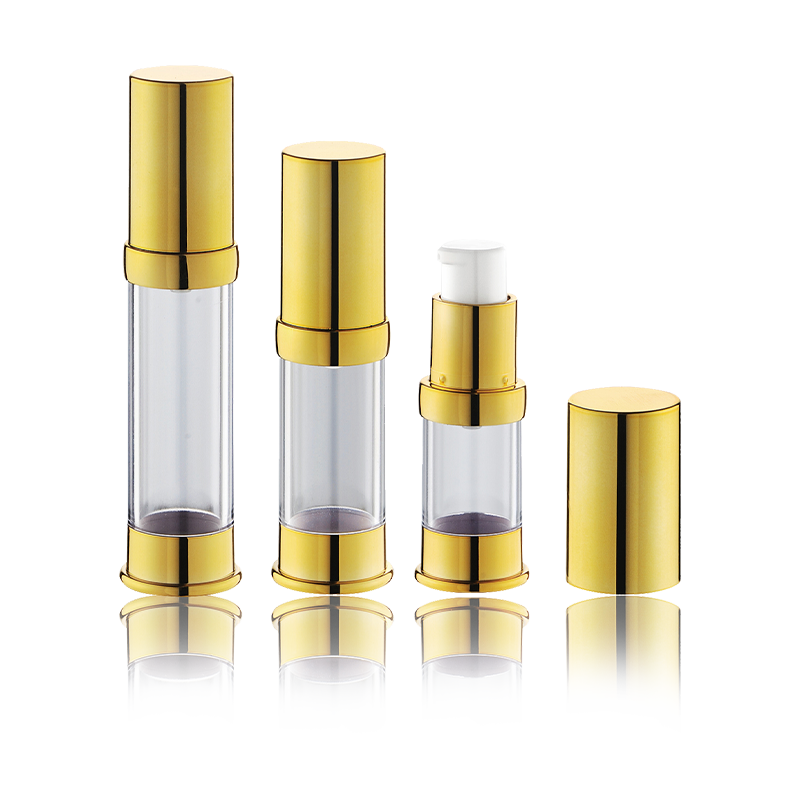 Hongsheng Single-Chamber Vacuum Bottle HS-001A in Three SizesThis compact vacuum bottle offers 5, 10, or 15 ml capacities with a 20 mm diameter, ideal for validating formula stability before investing in dual-chamber tooling.View Product →
Materials and Technical Specifications to Define Before Quoting
Define every wetted material before requesting quotes; the inner chambers, sealing elastomer and pump components determine stability and shelf life just as much as the formula itself.
Inner chambers are commonly polypropylene (PP) or polyethylene-based, chosen for chemical resistance and cost. The outer shell may be PP, ABS for a rigid decorated surface, or a transparent polyester (PCTG or PETG) for a glass-like finish. Sealing compounds are usually thermoplastic elastomers and should be tested against your solvents and pH range.
| Material | Typical component | Key properties | Points to verify |
|---|---|---|---|
| PP | Inner chamber, pump parts | Chemical resistance, low cost | Clarity, compatibility with oils and solvents |
| PE | Liner or bag-style chamber | Flexible, inert | Barrier performance, weld strength |
| ABS | Outer shell | Rigidity, accepts plating and coating | Drop resistance, decoration durability |
| PCTG / PETG | Transparent outer shell | Glass-like clarity | Scratch resistance, unit cost |
Also confirm the stroke volume and ratio: most pumps deliver 0.5 to 1.0 mL per stroke, and the ratio between chambers is fixed by the pump structure. High-alcohol formulas can swell common elastomers, and oxidising actives such as vitamin C require compatibility testing with the wetted parts assembled, not individually.
Primary Applications Across Product Categories
Skin care is the leading buyer, but the same logic applies in any category where two phases must remain separate until dispensing.
- Skin care: two-step serums, spot treatments and daily products combining incompatible actives.
- Hair and body care: rinse-off and leave-on combinations that mix at the nozzle.
- Cosmeceutical and pharmaceutical lines: dose-controlled lotions, gels and dermatological treatments.
- Industrial and home care: concentrated formulas that stay separate until dispensing.
From a procurement perspective, the business case strengthens when the package lets a product lower preservative load, deliver a fixed-dose claim, or command a higher retail price.
Sourcing Pitfalls and How to Avoid Them
Most failures appear only after production starts, and they trace back to a small number of controllable causes. Use this checklist when qualifying a supplier:
- Run accelerated stability tests with your actual formula in the actual pump and chambers.
- Measure the delivered dose ratio at production speed; drifts show up in filled units, not empty shells.
- Set a written leak-test method and defect limit, commonly AQL 2.5 for major defects.
- Check decoration durability on the outer shell, including alcohol resistance and drop testing.
- Clarify mold ownership and tooling costs; dual-chamber molds are more complex and usually require multi-component tooling.
How to Qualify a Manufacturer for Dual Chamber Airless Bottles
Qualify the supplier on three capabilities: in-house injection molding, in-house decoration, and OEM responsiveness. A trader can quote a good price, but only a factory can control the moulding tolerances, surface finish and assembly consistency that airless systems depend on.
Yuyao Hongsheng Commodity Co., Ltd., an OEM cosmetics packaging manufacturer with molding, printing, plating and assembly under one roof, is one example of an integrated factory that can support this type of development programme. Sample-based orders are a practical entry point: send an existing sample or drawing, and the factory matches structure, material and decoration before volume production.
Because dual-chamber tooling is expensive, the lowest-risk path is to validate the formula and pump behaviour in a proven single-chamber vacuum bottle first, then migrate to the dual-chamber structure once sales volume supports the tooling. The vacuum bottle range from Hongsheng covers standard airless formats for that validation stage.
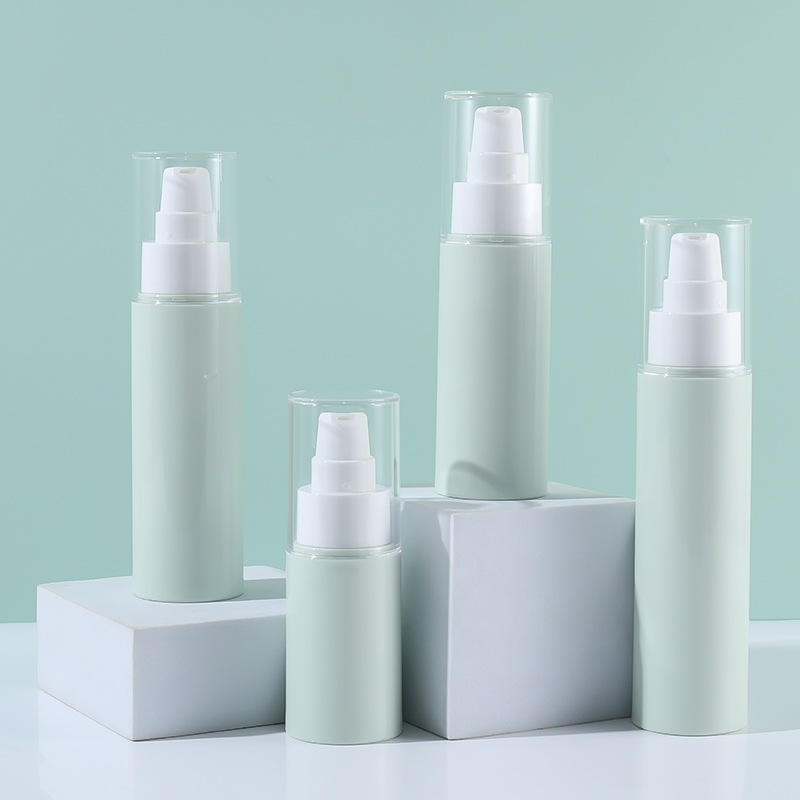 Hongsheng Airless Bottle HS-017A with Matte FinishA matte white airless bottle with brown cap, available in 50 to 120 ml sizes. Its screen-printed body adds depth, suited for lotion to cream formulas needing oxidation protection.View Product →
Frequently Asked Questions
Can a dual chamber airless bottle handle two different viscosities?
Yes, within a range. Most dual-chamber pumps are designed for lotion- to cream-viscosity products. Large differences in viscosity require a custom pump design or a modified ratio, so always test the actual formulation in the actual pump.
What is the typical dosing ratio?
1:1 is the common starting point, and 2:1 or 3:1 ratios are possible when specified at the design stage. Measure the delivered ratio on filled units during sample evaluation rather than trusting the pump data sheet alone.
What materials are used for the inner chambers?
PP and PE are the most common, with PP preferred for chemical resistance and PE for flexible liner-style bags. The sealing elastomer also matters; it is often the first component to swell or harden in compatibility testing.
What is a reasonable minimum order quantity?
MOQs depend on whether the molds already exist. Stock-mold products can be ordered in small batches and are commonly available for sample-based orders; fully custom molds tie the MOQ to tooling amortisation, so ask for mold cost, unit cost and decoration charges listed separately.
A dual chamber airless bottle is a specialised purchase: the tooling is more complex, the pump interacts with two formulas at once, and the unit cost is higher than a single-chamber alternative. Define the ratio early, test with the real product, and qualify the manufacturer on in-house molding, in-house decoration and responsive OEM support. A supplier that performs those three well on simpler airless formats today is the safest route to a successful dual-chamber launch tomorrow.