
 English
 中文简体
The short answer: 24/410 and 28/410 describe necks of different diameters — 24 mm and 28 mm — built around the same 410 thread profile. A closure made for one will not seal on the other, and no gasket, torque setting or adapter changes that.
That single fact carries most of the decision. The 24/410 neck is the slim option: 30–250 ml bottles, fine mist sprayers, small lotion pumps, disc-top and flip-top caps, mostly skincare and travel sizes. The 28/410 neck is the workhorse for 250 ml and above: shampoo, conditioner, body wash and large lotions, where a wider opening fills faster and a bigger pump delivers a dose that feels right in the hand. What follows explains the code, compares the two on the numbers that matter, and lists the checks worth running before anyone cuts a mold.
How to Read the Code
Read a neck finish code as diameter first, thread second, and treat both halves as pass/fail requirements rather than preferences. The number before the slash is the nominal neck diameter in millimetres, normally measured across the finish. On most supplier drawings that is the T dimension, taken over the threads; a few suppliers quote the E dimension, the bore. Ask which one you are being quoted, because the two differ by roughly the thread depth.
The number after the slash is the thread finish style. The 410 sits in the 400 series and is a short-neck profile: a nominal thread height around 10 mm and roughly one and a half to two turns of engagement, which is why lotion pumps and disc-top caps seat on it so quickly. It is not the same as 415, which uses a taller neck and more thread, and it is not the same as 400.
| Part of the code | What it controls | Example |
|---|---|---|
| First number | Nominal neck diameter in millimetres, measured across the finish (the T dimension on most drawings) | 24 or 28 |
| Second number | Thread finish style: profile family, thread height and thread position. It decides how far a closure travels before it seats | 410, a short-neck 400-series finish |
24/410 vs 28/410 at a Glance
Treat the comparison below as a default, not a law: a 200 ml serum can sit on a 28/410 neck if the pump and dose justify it, and a 500 ml hand soap can sit on a 24/410 neck if the brand wants a slimmer silhouette. The physical differences, though, do not bend.
| Attribute | 24/410 | 28/410 |
|---|---|---|
| Nominal neck diameter | 24 mm | 28 mm |
| Typical bottle volume | 30–250 ml | 250–1000 ml |
| Common products | Serums, lotions, hand gel, travel and trial sizes | Shampoo, conditioner, body wash, large lotions, household cleaners |
| Closure options | Fine mist sprayers, slim lotion pumps, disc-top and flip-top caps, droppers | Lotion pumps with larger output, disc caps, flip-top caps |
| Fill opening | Narrower, so thick formulas fill more slowly | Wider, so viscous formulas fill faster with less stringing |
| Closure weight at equal wall | Baseline | Roughly a third heavier, since weight scales with diameter squared |
| Typical application torque | 12–18 in-lb | 15–22 in-lb |
| Visual effect | Slim, skincare-led | Robust, hair-care and family led |
Why the Two Are Not Interchangeable
The 4 mm difference is the whole story: a 24/410 cap drops onto a 28/410 neck without ever touching a thread, and a 28/410 cap sits on a 24/410 neck like a lid on a jar — it spins, it does not seal. Thread engagement does not merely hold the closure on; it pulls the sealing surface against the bottle land, and without it there is no seal to test.
- Forced assembly hides the problem until transit. Operators push a wrong closure down, it bites a thread turn or two, the capping head reports acceptable torque, and the leak appears after a pallet has been dropped.
- Cross-threading damages both parts. On thin-wall PET, over-tightening a mismatched cap can ovalise the neck or start a stress crack at the thread root.
- Removal torque data becomes meaningless. Readings taken on a mismatched pair tell you about friction, not about the seal.
- The near-miss is worse than the obvious mismatch. A 24/410 bottle and a 24/415 cap look identical in a warehouse bin, and one of them will bottom out before the gasket compresses.
Sealing itself is a small system: the bottle land, the closure's sealing ring or liner, the gasket material, and the torque that compresses them. A PE liner on a lotion pump behaves differently from an EVA or silicone gasket, particularly with oils and alcohol-based formulas, so the closure choice should be validated with the actual product rather than with water.
When 24/410 Is the Right Call
Choose 24/410 when the bottle is under about 250 ml, the formula is thin to medium, and the package has to look precise: a slim shoulder, a small pump collar, a low-profile disc cap. It is the highest-volume neck size in skincare, which usually means more stock closures, lower minimums and shorter lead times than any custom size.
- Serums, essences and toners where 0.5–1.0 ml per stroke is the intended dose.
- Travel, trial and sample sizes where the closure is a significant share of unit cost.
- Fine mist sprayers, which look out of proportion on a wide 28 mm neck.
- Retail sets that pair a small bottle with a jar in the same footprint.
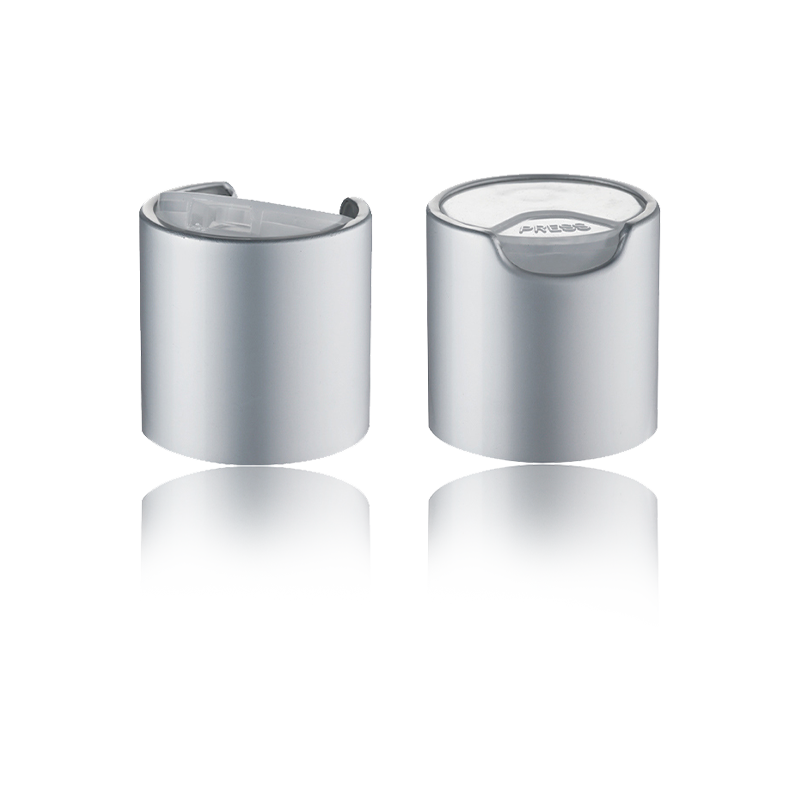 Disc Cap-HY-Q03AClassic bright silver push-type cosmetic Disc Cap-HY-Q03A is a bright silver universal cosmetic box cover with a minimalist push-type opening and closing design. It fe...View Product →
One caution: narrow necks slow filling of thick gels, and some contract fillers quote a surcharge for 24 mm openings on high-viscosity products. If the formula is above roughly 5,000 cps, price the fill line before you commit to the smaller neck.
When 28/410 Earns Its Extra Diameter
Choose 28/410 when the pack is 250 ml or larger, the product is thick, or the consumer expects a generous dose — a 2.0 ml stroke on a 400 ml shampoo is normal, and the pump chamber that produces it needs the wider neck to sit in.
- Hair care, body wash and household cleaners, where filling speed matters more than silhouette.
- Thick lotions and creams that would bridge or trap air in a narrow opening.
- Products filled on high-speed rotary lines: the extra 4 mm reduces drip and cleaning downtime.
- Refill formats, where a wider opening helps the consumer pour without a funnel.
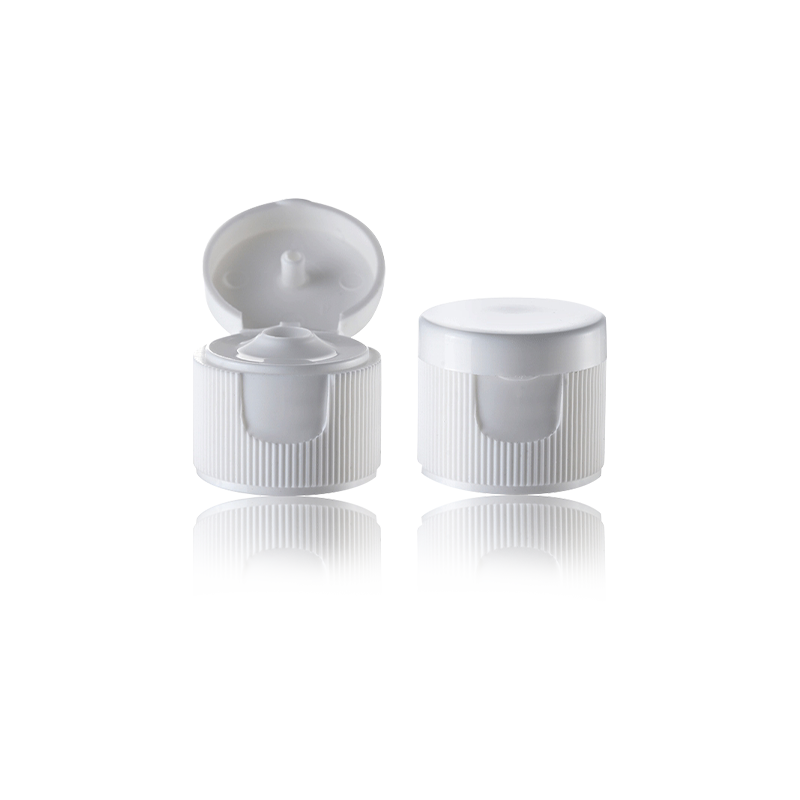 Butterfly Cap-HY-F02Precision closing cosmetic cosmetic Butterfly Cap-HY-F02 is a precision hinged cover designed for high-end cosmetic packaging. It adopts a butterfly-style opening and ...View Product →
The trade-off is material and presentation. A 28 mm closure uses noticeably more resin, a 28 mm pump sits visually heavier on a 100 ml bottle, and the whole package gains height once the pump is added to the carton.
Cost, Tooling and Capping Line Effects
The cost gap is smaller than most briefs assume, but it is real and it sits in three places: closure resin, bottle resin and line speed. Closure weight scales roughly with diameter squared, so at equal wall thickness a 28 mm cap or pump collar consumes about 35% more plastic than its 24 mm counterpart — and that gap widens with tall pump bodies and decorated collars.
Tooling and minimums
Both sizes are well served by stock molds, so a first order rarely needs new tooling. Custom shoulders, engraved collars or metallised finishes will carry their own minimums, and those minimums are usually higher on 28 mm parts because fewer standard shells exist.
Capping equipment
Capping chucks, grippers and change parts are size-specific. Running a 24 mm and a 28 mm pack on the same line is normal, but the changeover is not free — plan the two SKUs in blocks rather than alternating them shift by shift. Torque targets also differ: the wider 28 mm finish carries the same applied torque over a larger circumference, which changes the removal torque the consumer feels. Pump behaviour adds another variable, and the mechanics of stroke, spring and ball valve are worth reading up on before you lock a dose.
If you are comparing closures from more than one source, the practical shortcut is to shortlist by neck size and finish first, then compare dispensing performance — our note on analysing cosmetic cream pump heads covers the second half of that comparison.
A Spec Checklist Before You Place an Order
Neck finish problems are almost always documentation problems, so settle these eight points before the purchase order goes out.
- Confirm the T and E dimensions on both the bottle drawing and the closure drawing, and check which one each supplier quotes.
- State the finish code explicitly — 410, not "standard" — and ask for it in writing on both sides.
- Check thread position and thread starts; a 410 with a different start position will seat at a different angle.
- Match the gasket or liner material to the formula, especially for oils, acids and alcohol.
- Set application torque from a trial, then measure removal torque after 24 hours, not immediately.
- Cut dip tubes to bottle height minus 2–3 mm so the tube rests slightly curved rather than against the base.
- Run an inverted leak test and a drop test on filled, capped units before approving the pilot run.
- Keep a sealed reference sample of the approved bottle and closure pair for incoming inspection.
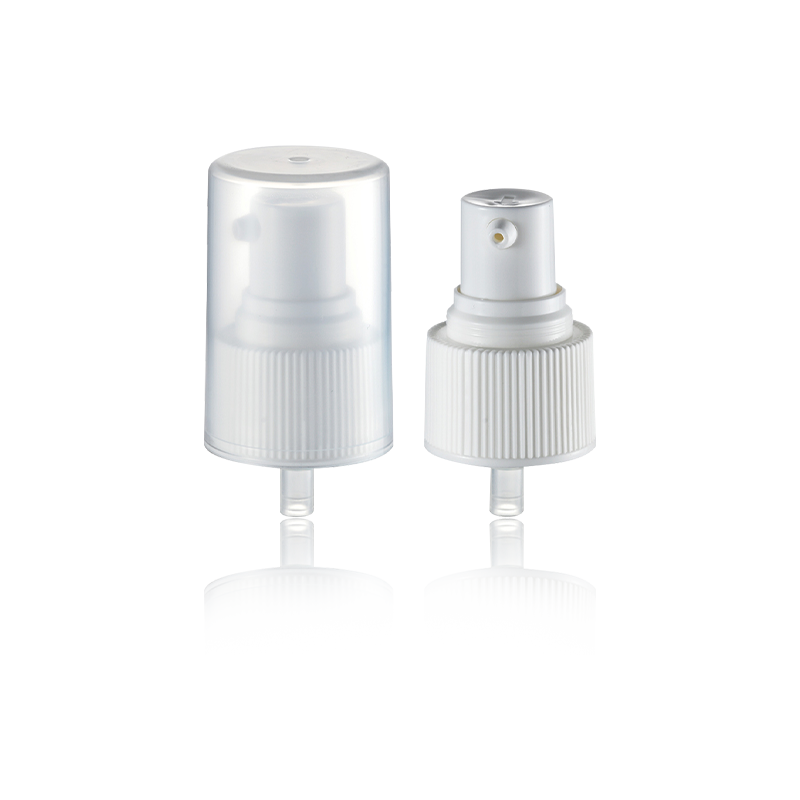 Liquid Distributor-HY24A-01View Product →
Both neck sizes are standard items in the bottle, pump and cap range, which means samples for a fit trial can usually be pulled from existing molds rather than built.
Frequently Asked Questions
Can I use a 24/410 pump on a 28/410 bottle?
No. The pump skirt is 4 mm smaller than the neck, so the threads never meet. The pump will sit loose at an angle and leak as soon as the bottle is tipped.
Is a 24/410 cap the same as a 24/415 cap?
No. The diameter matches, but the 415 neck is taller and carries more thread, so a 410 closure bottoms out before its sealing ring compresses, and a 415 closure may not pull down far enough on a 410 neck.
Does a 28/410 cap fit a 28/400 bottle?
Generally not. Both are 28 mm necks, but 400 and 410 use different thread profiles and heights, and the mismatch shows up as a loose or non-sealing fit. Never assume interchangeability across finish families.
Which size is cheaper?
The 24/410 is usually cheaper per unit for closure and bottle alike, mostly because the parts weigh less and stock options are deeper. On a 400 ml shampoo, though, the 28/410 often wins overall: faster filling and fewer rejects can offset the resin.
Can I change the pump without changing the bottle?
Yes, as long as the new pump uses the same finish and diameter. Fine mist sprayers, lotion pumps, disc-top caps and flip-top caps are all available on both standards, so a pack can be repositioned without touching the bottle mold.